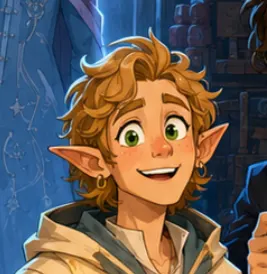
Played by David
Fëanor Dawnward
A rich family's black sheep, a priest who insists he isn't one, and the man who killed the Baron. "I'm not a priest. I'm just a lost boy."
- Ancestry
- Elf
- Class
- Cleric of Lathander
- From
- Waterdeep
- Level
- 5
- Heirloom
- A round, flat stone engraved with a three-pointed star
Fëanor is the black sheep of a very rich Waterdeep family, dressed down on purpose ("trying to slum it"), too young to drink by elf reckoning, and a cleric of Lathander who would rather not talk about it. He refused to prepare any spells in the Durst house because "Spells are so bourgeois", and then, when the ghouls came up out of the ground, raised his holy symbol and turned the lot of them. Sirius's verdict that night still stands: "You said you weren't a man of particular faith. You're the best priest I've ever met."
He says "just for the avoidance of doubt" a great deal. He does not eat dairy. He had his first drink ever in Barovia.
The Dawnwards
His mother, who keeps a full jewellery box and a mirror on the ceiling, sent him out on the errand that brought him here: finding a smith for the family horses, because he drew the short straw against his elder siblings. His brother preaches purity. An uncle and aunt had "some problems with tax, and they had to flee". His father he won't describe: "You don't know my father." The only one who ever paid him real attention was his grandmother, who gave him the stone.
Somewhere along the way he read "an interesting book" that changed his whole view of religion and aristocracy. "I think there's something better out there for all of us. Something fairer." He goes to church, he says, as a rebellion against his parents. He once stormed out of the temple yard over Brother Fawcett's croissants: "They're bourgeois." (He and Sirius agree that the bourgeois are a kind of devil.) Osric has offered him a summer on the farm in Goldenfields.
The star stone
A round, flat stone engraved with a three-pointed star. "Only sentimental value." It rolled away ahead of him through the mist, always just out of reach, until it stopped at the foot of the stairs.
Since then:
- Ismark half-recognised the symbol from "old stories about nature" and couldn't place it.
- A moss-grown standing stone by the road west is ringed with the exact same symbol, around a carving of a winged woman with three eyes. Neither the symbol nor the woman has ever been shown or spoken of in the world we come from. Fëanor took a rubbing.
- He told us the stone glows at the new moon, in a land where none of us has ever seen a moon.
At Tser Pool he asked Madam Eva whether fortune-telling went against his faith. "That is for you to answer. How strong is your faith, really?" He drew the Wizard and then the Mists:
"You channel the power of a god you scarce believe in." ("I just told you that.") "The stone in your pocket remembers a fire you have never felt." ("Who told you?") "The sun only hides in this land behind the mists. In water it glows still. Stand there at dawn and choose."
We think the water is the glowing pool behind the walls of Krezk. What he's meant to choose, nobody knows. See The Reading.
In Barovia
- Death House. He walked into the mist hand in hand with Sirius ("We're a team"), looked at the scorned baby in the family portrait and said "I know what it's like to feel like you're not there," and wondered aloud whether the dog was the gift the monster wanted. He gave the dead maid a kind sermon about the afterlife (a nice place, afternoon tea, no servitude) and threw the cult's notebook down the well. He killed the woman in the wall with a fire bolt through her black heart, turned four ghouls, and spotted the crystal heart inside the flesh mound: "Look at the crystal heart."
- The village. He ate a whole pie ("I'm a growing boy") and dreamed bright dreams he couldn't remember. He read the villagers' old dawn gesture as Lathander's. When he made Father Donavich's holy symbol shine, the old priest thought he was seeing a miracle. In the crypt he was the first to say what Doru was: "I think he's already dead." He argued the grieving father round, and struck first when the father gave his leave.
- Strahd's first visit. He was the only one of us who saw the charm for what it was. "You are all charmed. Why would I lie about this?" He met the devil on the stairs with a readied bolt of light and missed, and Strahd laughed: "It is good to see some backbone in some fresh blood." Then he fell under it too. In the morning: "I told you."
- The tavern. He admitted he was feeling hopeless. Sirius: "You are the sun in these lands, Father." Fëanor: "I need to connect with my God for the first time."
- The windmill. His guiding bolt did more to Morgantha than anything else we threw. He claims he's immune to the pies. His detect magic proved they were enchanted, and that the same magic was wound round Lily's head.
- Wachterhaus. "This place stinks of new money." He was the table's hard sceptic about Lady Wachter from the start: "I don't trust her as far as I can throw her." He went to the bathroom with Sirius to confer about the fiend on the perch ("close followers of the Morning Lord"). On the walk home he turned dark: "I would like to go home sometime. And if I can't go home, then I'm gonna take as many things out with me." The Ravens' note said he'd been right about her.
- Hostage. The Baron kept him as collateral, and he went along with it. He spent the vampire night and the burning of the church as the Baron's guest.
- The festival. With David away, the table ran him, and he made history. When the Baron ordered Izek to kill Sirius, Fëanor sent a lance of silver down a line through the imp, Izek and the Baron. Vargas Vallakovich died on his own stage. Then he urged the crowd on at Lady Wachter. Afterwards he read Victor's spent teleportation circle for exactly what it was, and put the Reformation Center's two courtroom guards to sleep without a scratch on them. The table voted him most valuable player. How he feels about any of it, we don't yet know, and neither, perhaps, does he.
What Barovia has done to him
It took two days. Izek brought him back to us at the burned church: "You can have most of him back." His last memory is going to the Workyard to ask about some nails. Then there's something the DM told David alone, and then he was standing in a roofless church. "Is this the mist? I feel like I've been in the mist again." All he can say is "I met a nice boy." Boy height. Very boy-like. Sirius lost half an hour to the same boy, in the same attic. We now have a rule: never go upstairs in the Baron's house.
It has also made him answer for his faith, over and over, to people who need it more than he does. "I'm not a priest," he told us in the woods. "I'm just a lost boy." At level five the Morninglord answered him with spirit guardians. He took it well, apart from Sirius's horse.
In his own words
"We have to eat the rich."
"It looks like me, but it doesn't look like me." (At the Durst house mirror.)
"I don't know about death." (At the children's grave.)
"He absolutely will not get better. It's not a flesh wound or a mild cold."
"When I turned twelve, the Morning Lord gave me a book token. I certainly didn't get any bloody horse. I'm just fighting my envy."