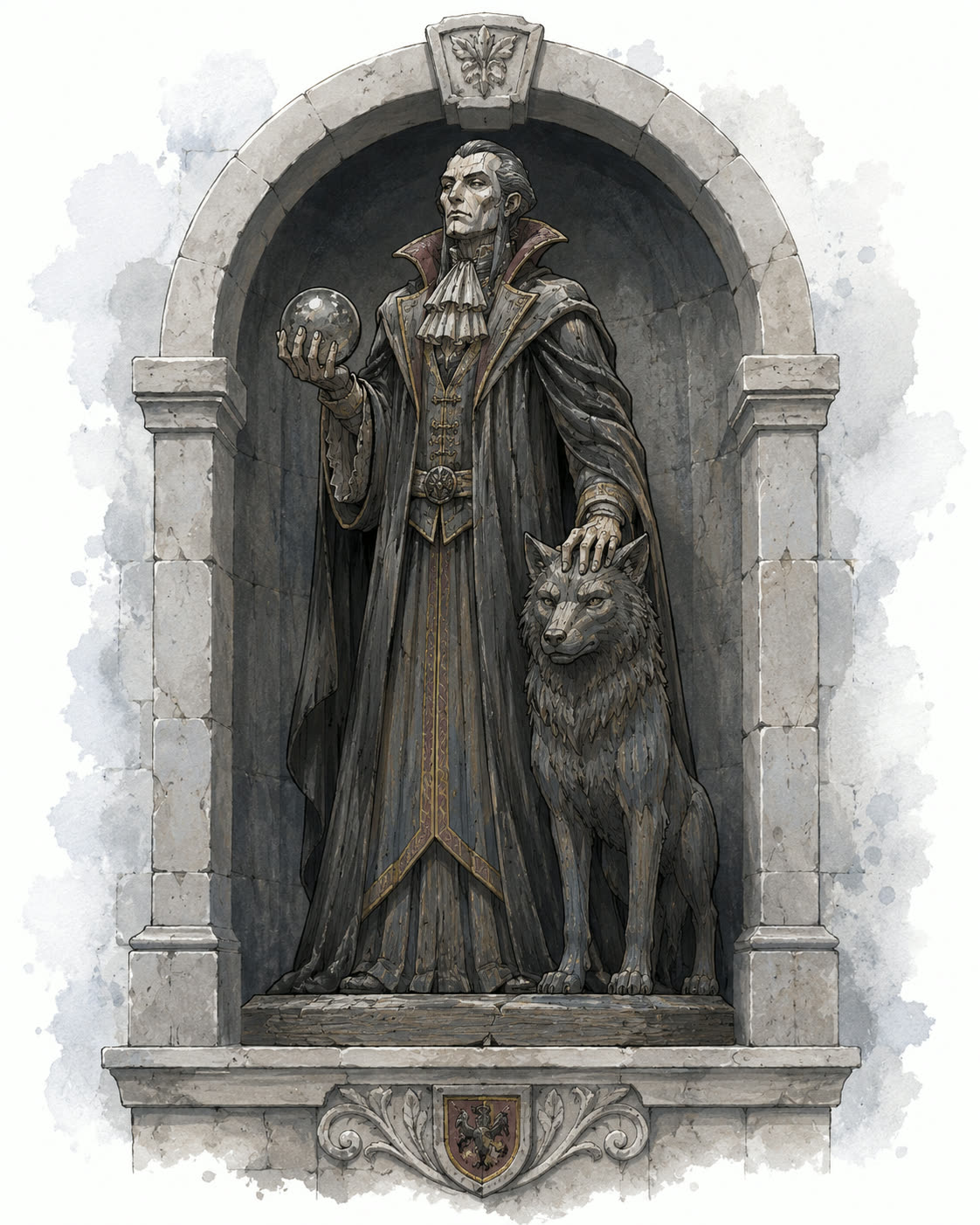
Who: “Ruler of these lands, rightful lord” — his own words. The villagers call him the devil.
Where: Castle Ravenloft, marked on our map with one word: AVOID!
Status: Very much active. He has met us. He has fed on one of us.
First encountered: By name in Death House (Session 1); in person at Ismark’s house (Session 5).
The statue above is how we first saw his face — carved in painted wood, in a hidden room beneath Death House, one hand on a wolf’s head. We’ve since seen the face itself. The statue flatters him less.
What we know
- He is a real vampire. Not a story, not a metaphor. Ismark told us plainly; Doru was his proof; the bite on Sirius’s neck settled any doubt.
- He rules this land — and may, in some sense, be it. The cult under Death House chanted “He is ancient. He is the land.” Strahd himself told us: “I am this land, and this land is me.” His face is on the coins. His sigil is over the gates. The engraving calls Barovia “the crown jewel in the Strahd empire.”
- The mists are his walls. There is no leaving Barovia. The mists are the bars of the cell, and Strahd is the jailer (Ismark’s words).
- His charm is total. When he visited, every one of us — except, for a few glorious minutes, Fëanor — simply knew he was a friend. Ireena watched the same spell hollow out her father. Assume anyone praising a charming stranger has been got at.
- He makes vampires only occasionally, mostly from people who are loved — “just to torment us” (Ismark). They return stronger, faster, and bound to obey his every word. See Doru.
- He killed the old burgomaster — not with fangs, but with sleepless terror, night after night, because the man refused him his daughter.
- He wants Ireena. That is why we are on the road.
- He knows about us, and he is entertained. “It has been decades since visitors brought me any spice… You may have your fun — but I get what I want.” He drank from Sirius as a “token of fealty” and left laughing at our backbone.
- The letter we found in Death House (signed “In darkness I endure”) shows how he treats his servants: see the Handouts.
- He mentioned, in passing: “one of my pups managed to grab you… it will recover, and I have others.” We don’t know what that means yet. We should find out before it matters.
The letter (Session 7)
On the road to Vallaki, a dire wolf stood waiting in broad daylight with roses in its mouth — straining against itself, visibly made to be gentle — laid them down, and fled. Around the stems: a note on fine card stock, addressed to Ireena. The full text is preserved in Handouts; the lines that matter:
“My love, why do you tease me so? … merely speak my name thrice, and I shall be with you in the moment to whisk you to our castle, Ravenloft. Your destined future lover, Strahd von Zarovich.”
So: his name, spoken three times, summons him — by his own written promise. We are, of course, already designing traps around this; we are also aware he wrote it down for us to read, which lowers our confidence that it’s a weapon pointed only one way. The working comfort, per Fëanor: he calls us ruffians, he sends flowers — he is still in the gift phase. That buys time. Some.
What the Vistani told us (Session 6)
- The Vistani pass the mists by an ancient agreement with him — he leaves them be, they leave him be. They are not his allies; they are exempt, and they know it. Barovians, in their words, are “property of Strahd.”
- He has been exactly as he is for some seven hundred years. Unchanged. If any living person knows his history — say, whom he ever envied — the Vistani do not. The answer, if it exists, is written down somewhere.
- There are other lands like this one — the Vistani call them the Domains of Dread — and ordinary sunny places beyond: the Coast of Faerûn, Waterdeep. Home still exists. This place just doesn’t let go.
- And from Madam Eva’s reading, the last card: when the time comes, we will find the devil “in the tomb of the only man he ever envied.” A tomb. A name nobody remembers. See Quests & Threads.
The letter to Lady Wachter (Session 13)
We have now read his correspondence, and we wish we hadn’t. Found in an iron chest in Lady Wachter’s own bedroom: a letter from the devil to the lady — courteous, precise, and stranger than any accusation we’d prepared. It does not order the Baron overthrown. Read carefully, it says: keep the Baron. Keep the status quo. Do it subtly — with her succession blessed only if the ruling family should happen to fall, and a warning not to bloody her hands doing it. Lawfully evil. The full text is on Handouts.
Then Izek confiscated it and carried it to the Baron — the man the letter quietly favors. Our best evidence now props up the regime it should indict, held by a ruler who kept the accusation and buried the signature. We assume the author finds all of this very entertaining.
Open questions
- How long has he ruled? The Vistani finally gave us a number: ~700 years.
- What does “I am this land” actually mean? The cult believed it literally.
- Why does he court Ireena rather than simply take her?
- What are his “pups”?
- Who is the only man he ever envied — and where is that man’s tomb?
- Why does the devil want the Baron kept? What is the status quo for?